
S-01 Solutions · Stadiums
Event-day orders that land in a full bowl.
Gate, concourse and field staff get the order on a staff tag or in the team app, and each answer returns to the command post by name, while the building's cell and Wi-Fi are saturated by the crowd.
For: stadium operations, security and guest-services leads, and the command post that runs event day.
01 The event-day gap
With the bowl full, the command post loses sight of who has the order.
Cell fails at capacity
Stadium data uploads failed up to 46% of the time on game day in a 2026 preprint. At one Super Bowl, a carrier failed 16% of data connection attempts.
Radio has no roll call
One shared channel, no answers and no record. In a lightning hold, nobody can show which gates have the order.
The result
The command post runs on radio chatter instead of a list of names.
Sources: arXiv 2607.16008 (preprint); RCR Wireless, February 10, 2010 (Super Bowl XLIV). Checked October 30, 2026.
02 A lightning hold Simulated site plan
HOLD to all 4,000 staff, and a list of who has it.
- 01
Hold sent
The command post arms HOLD and sends it to every gate, concourse and field team, or to one gate, one section or one role.
- 02
Tags and phones
Staff tags buzz and the team app shows the hold, with cell assumed jammed.
- 03
One press
Each tag answers in its own time slot, so 4,000 replies do not collide.
- 04
Gaps by zone
The command post sees names by zone, who is silent, and the reason: node down, jammed or out of range.
Fan-facing broadcast and fan HELP to staff are built behind a feature flag and not field-tested. There is no fan-to-fan messaging.
03 Deployment Simulated
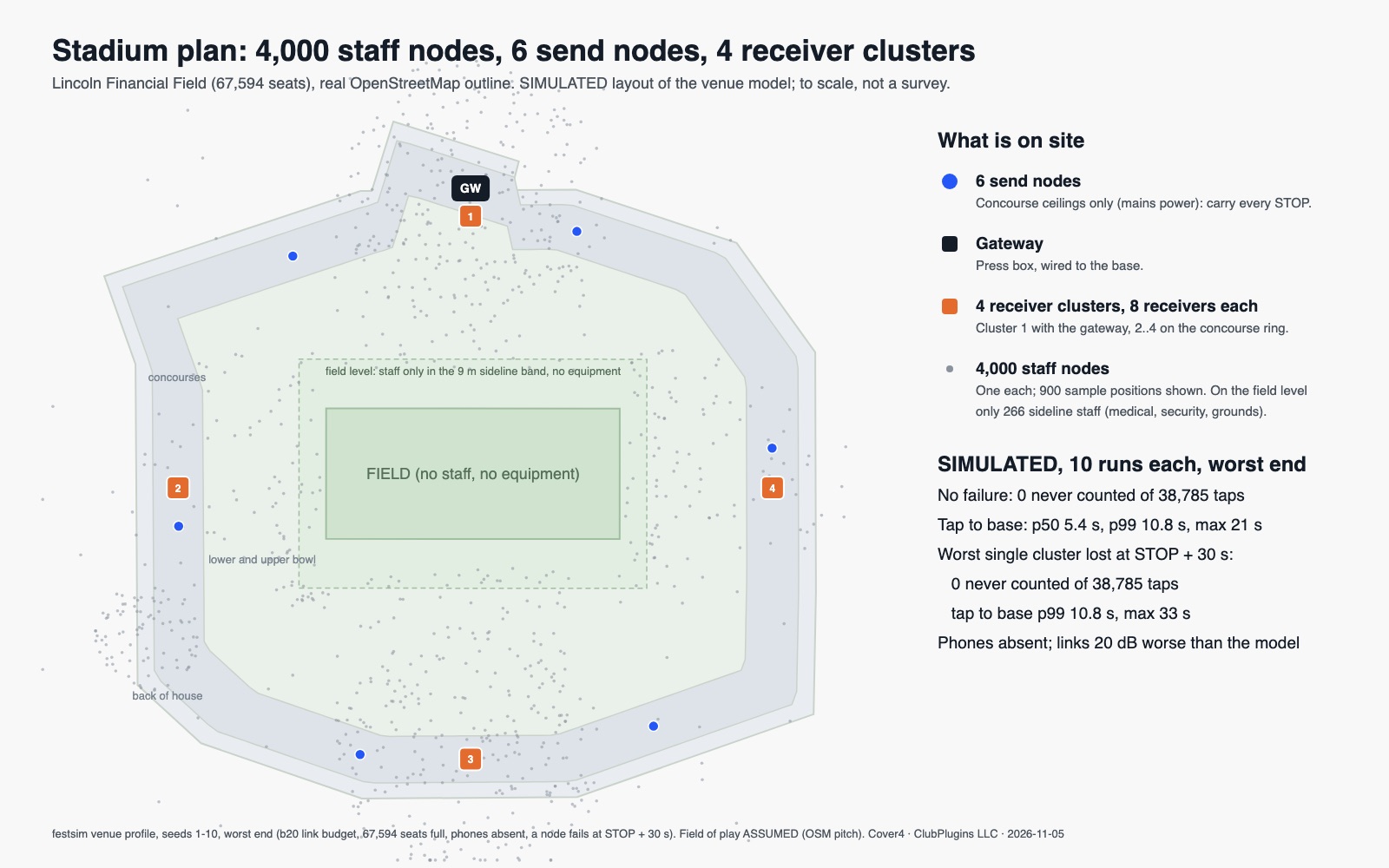
Six send nodes on the concourse ceilings and four receiver clusters.
| Venue model | An NFL bowl on its public outline, 67,594 seats. No staff or equipment on the field of play. |
|---|---|
| Staff | 4,000, each carrying a tag |
| Send nodes | 6 on the concourse ceilings: a simulated minimum of 4, plus 2 spares |
| Receiver clusters | 4: one with the gateway in the press box, three on the concourse ring |
| Taps counted | 38,785 of 38,785 over 10 runs |
| One cluster lost 30 s after the STOP | 0 taps uncounted, whichever cluster was lost. 99% reached the control center within 10.8 s; the slowest took 32.9 s. |
| Test conditions | Every radio link 20 dB worse than the planning model, no staff phone answering (tags only), one send node down. |
| Site simulator, 10 runs, worst end. Simulated, not measured. A range test at the venue comes before any node count is quoted. | |
04 What you keep, what Cover4 adds
Radios stay for talk. Cover4 carries the orders that must be confirmed.
You keep
- Your radios and channels, for conversation.
- Your PA, evacuation system and fire alarm.
- Your team or event app: Cover4 runs inside it through the SDK, or on the Cover4 crew app for a pilot.
- Your building network, which Cover4 uses first when it is up.
Cover4 adds
- One-to-all orders that reach every staff tag, not only whoever holds a radio and is listening.
- A roll call without airtime: answers by name in seconds, with the reason for each gap.
- Targeting by gate, section, role or person.
- HELP with a typed message, placed at the nearest node, without waiting for a gap on a busy channel.
- A tamper-evident record of who was told what and when, for the post-event review.
05 Proof and security
What has been measured, and how the lane is protected.
| Stage | Date | Result |
|---|---|---|
| Bench | 2026-10-26 | STOP confirmed by name in 3.1–4.6 s, tap included, on phones never paired and with Wi-Fi off. |
| Bench | 2026-10-29 | Control center killed mid-alert: the backup took over in 15 s and re-sent to the 5 unconfirmed. |
| Bench | 2026-10-30 | Relay jammed: the reply routed around it, confirmed by name in 2 s. |
| Simulated | 2026-11-05 | 110 NFL, NBA, MLB and NHL venues, each receiver cluster lost in turn, 3 runs per venue: 83 count every tap with 3 clusters and 27 need a fourth. Counting only taps made within 240 s of the STOP, 107 hold at 3 clusters and 3 need a fourth. Our rule: at least 3 per venue. |
| Not yet shown | open | Any venue walk or event. Coverage across a full building is measured by a walk test at the venue. |
Only the site can send
Every order is signed at your control center. Devices reject anything unsigned, altered or replayed, so a fake STOP goes nowhere.
HELP stays private
HELP messages and operator replies are encrypted end to end between the staff member's phone and the site's control center.
The record stays with you
Kept on site, hash-chained with signed checkpoints, and checkable offline without contacting us. Security details
- Bench-tested on our own boards and simulated at venue scale. Not yet field-tested; the pilot is the field test.
- Designed to FCC Part 15.247, not yet certified, so permanent installation waits on that route.
- On iPhone, a force-quit app or Bluetooth switched off stops phone alerts. The staff tag alerts and confirms on its own.
- Push-to-talk over Cover4 nodes passed a first bench test on two boards. Range, multi-hop and iPhone audio are not proven, so radios remain the voice tool.
A pilot across a run of home events.
We start with a site walk with your operations and security leads, then run one event or one zone, such as the staff entrances and one concourse, beside your radios. You receive the by-name confirmation record and a measured coverage map. Pass mark: every order answered by name, or flagged with the reason.
partners@getcover4.com